
Can you take over production mid-season?
Yes, and it is a routine job — but only when the incoming specification is complete. Taking over a running line is not the same as starting a new one. The product already exists, already has artwork, and already has a customer base that will notice any change. The work is matching, not inventing.
The realistic timing: samples in 7 days from final artwork, 7 days for your side to confirm, then a purchase order. That puts the first bulk run roughly half a month after approval, with production itself inside the standard 25–35 day window.
What we need before quoting a transfer
| Item | Why it decides the quote | What to send |
|---|---|---|
| Current specification | Thickness, adhesive class and liner set the coating recipe; a missing value becomes a guess on our side | The supplier spec sheet, or a physical sample |
| Dieline and artwork | Determines whether existing tooling can be reused or a new die is needed | Vector file with the die line on a separate layer |
| Tooling ownership | If you own the die, it can move with you; if the incumbent does, the shape is re-cut | Purchase record or the clause from your agreement |
| Pack format | Pouch dimensions, print method and count per pack set the packing line and the price step | A finished pack, plus the film structure if known |
| Regulatory position | US facility registration and EU responsible-person arrangements belong to the entity placing the product on the market, not to the factory | Which markets, and who holds the registration |
| Volume and cadence | A monthly reorder pattern and a twice-yearly container are priced differently | Units per order, orders per year, target first delivery |
| Colour references | Matching a running colour needs the actual reference, not a photograph | Physical colour standard, or the Pantone code if printed |
| Remaining stock | Decides whether we run a parallel batch or wait for a clean cut-over | Weeks of cover at current sell-through |
The four stages, and what can go wrong in each
1. Specification match. We read your existing spec and say which values we can hit exactly and which need a tolerance band. The honest answer sometimes includes a value we cannot reproduce — an adhesive from a supplier who does not sell to us, for example. That is worth hearing before the sample, not after.
2. Sample against your reference. The sample is compared to a physical reference, not to a description. This is the stage where a trial run reveals whether the colour reads the same under retail lighting and whether the peel feel survives the liner change.
3. Golden sample and approval. Once approved, the retained sample becomes the standard for the batch record. Six things get locked: mass thickness, adhesive coat weight, liner, die line, print colour, and pack construction.
4. First bulk run and parallel cover. Most brands run one overlapping batch so the shelf never empties. The first production batch is inspected against the golden sample, and the batch record travels with the shipment.
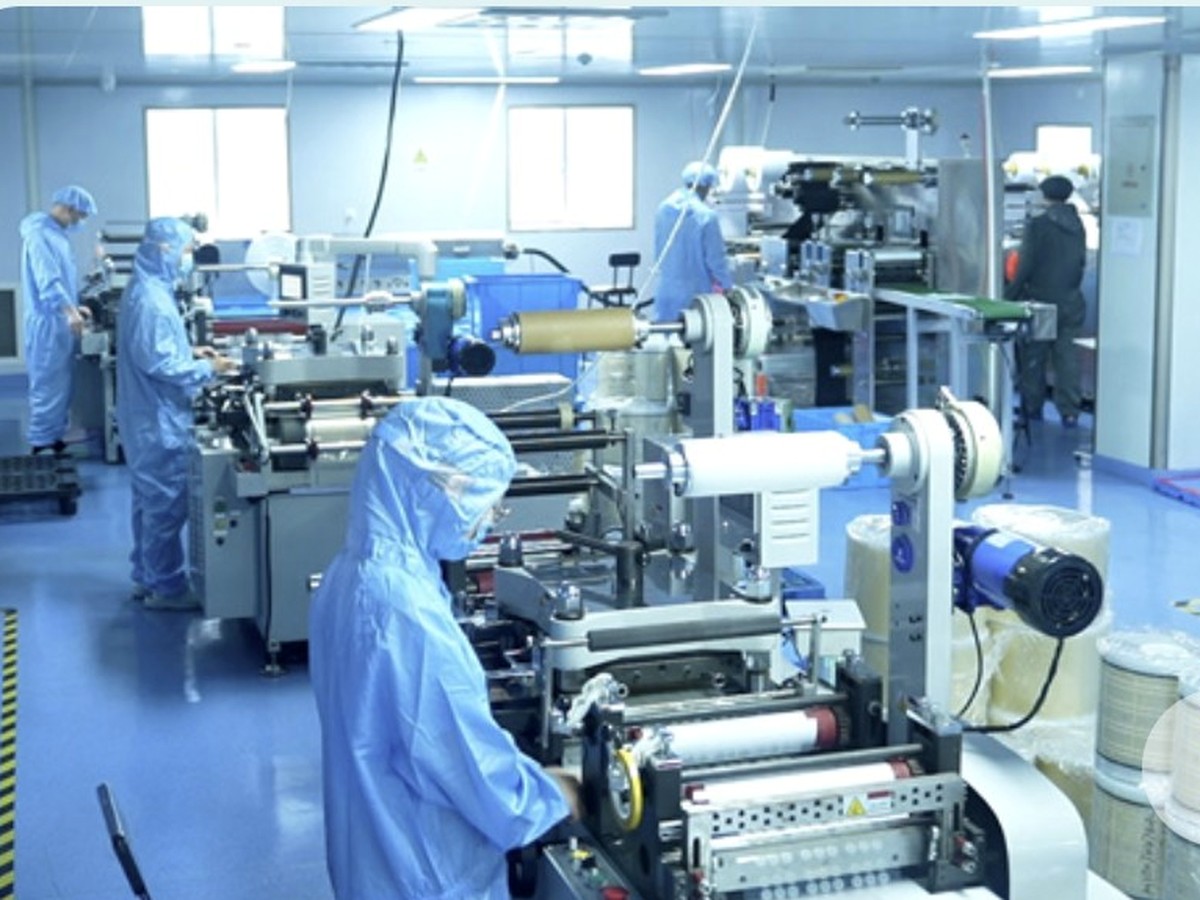
A transfer lands on running lines, not on a new set-up. The first bulk batch is compared against the retained golden sample, and the batch record travels with the shipment.
When a mid-season transfer is the wrong move
- Fewer than eight weeks of cover and no approved sample. A transfer cannot be compressed past the sample round without accepting a mismatch risk you will pay for at retail.
- The product carries a claim tied to a specific formulation. If the pack text names an active at a stated level, changing the mass means re-checking the claim, not just matching the appearance.
- Character or licensed artwork without documentation. We produce licensed programmes where the licence is held by the brand owner and granted to our client. Without that chain in writing, the artwork cannot be run.
In those cases the better plan is a staged switch: keep the current supplier for the season, qualify the replacement in parallel, and cut over at the next packaging change. That costs less than a rushed launch and a recall.
What the first quote will look like
We quote per design at a 1,000 unit minimum, with the price step stated for the volume band you expect. Tooling is charged once and, once paid, belongs to you — held in our workshop and used only for your orders. If you already own a die that fits our press, it can be transferred in and inspected rather than re-cut.
Two documents come with the first shipment: the batch record and the inspection result against the approved sample. Both are what an auditor asks for, and both are easier to obtain at the start of a relationship than to reconstruct later.
Background on how the factory is set up — 8 coating lines, 60–120 cm web width, ISO 13485 certificate 69136 — is in what a patch manufacturer actually sells you. If the transfer involves a formula rather than a design, ODM: when you want the formula sets out what ownership looks like. And if you are matching a competitor's sample rather than your own, the five parameters that have to be measured are covered in matching a sample from another supplier.
Send the current spec sheet and one finished pack. We will come back with what matches exactly, what needs a tolerance band, and what the first run would cost at 1,000 units per design.


Are you looking for a reliable manufacturer of acne patch products?
We can quickly provide customers with market analysis, technical support and customized services.
- Full Name:
- General Inquiry
- Tel:
+86 571-86043296
- Email:
- info@hensobio.com
- Address:
- 1-510 Tongpu Rd., Xihu District, Hangzhou 310012, China
- *Name
- Phone
- *Title
- *Content