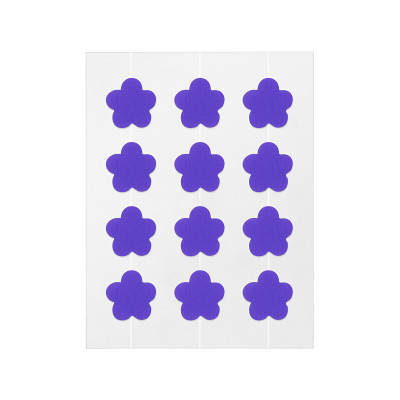
Hydrocolloid Acne Patches: Construction and Specification
A hydrocolloid patch is a four-layer construction, and every layer is a specification. Most buying problems in this category come from specifying the ingredient and leaving the construction to the factory — then discovering the pack behaves differently from the sample.
This page is written for buyers rather than shoppers: what the patch is made of, which dimensions actually change the product, and what to put in writing before a first run.
The four layers
Backing film. Thin, flexible, and the surface that carries print. Its stretch decides how the patch sits on a curved area.
Hydrocolloid matrix. The absorbent core — typically a carboxymethyl cellulose dispersion in an elastic binder. This is the layer that gels when it meets moisture.
Adhesive face. What holds the patch to skin for the wear time. Its aggressiveness is a trade-off: enough to stay, not enough to damage a compromised surface.
Release liner. The peel-off sheet. Trivial until it is too stiff to remove with one hand, which is a real complaint in reviews.
Only the second layer is mentioned in most marketing. The other three decide whether the product feels premium or cheap in use.
The four dimensions that change the product
The size arithmetic is worth remembering when a quote looks high: a 15 mm patch carries about three and a half times the material of an 8 mm patch. A price per patch without a diameter is not a comparable number.
What to put in writing
- Thickness in millimetres, not "standard". A tolerance of ±0.02 mm is normal; "as usual" is not a specification.
- Adhesion test method and result, measured at end of wear rather than at application.
- Absorption capacity stated per patch, with the test condition — humidity matters.
- Sterility or bioburden status, if the product is sold as a dressing rather than a cosmetic.
- Shelf life and the pack it was tested in. A stability result from a different pouch does not transfer.
Where samples mislead
A hand-made sample shows what the product can look like; it does not show what a production run can repeat. The gap usually appears in three places: adhesive coating weight, die-cut edge quality, and moisture pickup before packing. Ask for the production sample from the same line and the same pack, and ask what the reject rate is at each step.
For the mechanism behind the absorbency — what the patch does and does not do to a blemish — see how hydrocolloid works. For what makes a patch lift before its wear time is up, see why patches lift.
Send the four dimensions and the pack format and we will quote them together — thickness, adhesion, diameter and count behave as one product, not four independent choices.
Request a quote