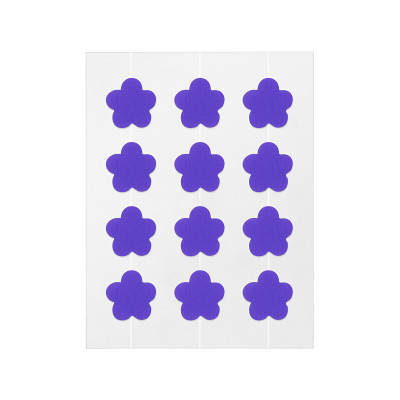
Custom Shaped Acne Patches: What the Die Line Decides
A shape is a tooling decision before it is a design decision. The drawing becomes a steel die, and that die decides how cleanly the patch cuts, how many fit on a sheet, and how long the job takes. Changing the shape after the die is made means buying the die twice.
Most shaped-patch projects arrive as a picture: a star, a heart, a character, a logo. What the factory receives has to become two separate files — a print file and a die line — and the second one is where the cost lives. This page covers what the die line decides, in the order it decides it.
Two files, and only one of them prints
Every shaped patch needs a print file and a die line. The print file carries the artwork: colour, logo, pattern. The die line is a single closed path that the blade follows. They are separate layers, and the die line must never print — if it is left visible on the artwork layer, it ends up on the patch.
Die line, closed and single. One continuous path, no gaps, no double lines. A broken path produces a patch that is cut but not separated.
Artwork inside the die line. Print extends past the cut edge as bleed, so a small registration shift does not leave a bare sliver on the finished patch.
Size, in millimetres. Stated as the actual cut size, not as the canvas size. We make 8, 10, 12 and 15 mm circles routinely; a shape is quoted by its bounding box and its narrowest part.
Why some shapes cost more before anything is cut
Three properties of an outline decide most of the difficulty, and none of them is visible in a flat preview.
points, ears, tails
A blade is a strip of steel. Where the shape narrows, the blade has less room and the sheet has less material to bridge. Points that look crisp on screen become rounded, and the smallest features may not release cleanly at all.
corners
An inside corner is where the blade turns hardest. Rounded internal corners cut more predictably than square ones, and the rounding is usually invisible at finished size.
against area
A shape with a long edge around a small area uses more blade travel and leaves more waste between copies. A star has more edge than a circle of the same width, so the same sheet yields fewer patches.
The circle is the reference case because the arithmetic is simple: an 8 mm circle covers about 50 mm², a 12 mm circle about 113 mm², a 15 mm circle about 177 mm². A 15 mm patch carries roughly three and a half times the material of an 8 mm patch. That ratio is geometry, before any waste or nesting loss — and nesting loss is exactly what a complex outline adds.
Where the shape meets the print
Print runs first, then the die cuts. That order means every copy has to line up with the same blade, so a shape with a long thin point is also a registration problem: the point is the place where a small shift is most visible. On printed shaped patches the working colour target is ΔE ≤ 2 against the retained master, and registration is checked at final size, not zoomed in.
Shape and colour are also linked commercially. A design in five spot colours on a star costs more to set up than the same design in two colours on a circle, and both cost more than the plain circle — see how print method and colour tolerance work for that side of the job.
The sequence, and where the days go
A shaped order moves through four stages, and only the middle two run in the factory.
The minimum for a custom run is 1,000 units per size and pack format, whether the shape is a circle or a character. Below that the die and the setup dominate the unit price. If the pack is a printed carton with a bespoke structure, that tooling is a separate clock and runs in parallel with the patch die — worth starting at the same time, not after.
What to send with the enquiry
The outline as a vector path, at final millimetre size, plus the narrowest part of the shape.
The artwork with spot colour references and bleed, on a layer separate from the die line.
The pack format and count per pack, because that decides the minimum and the packing line.
The market, because claims and labelling differ by destination and must be settled before artwork is approved.
Send those four together and the answers come back as numbers: the die lead time for that outline, the minimum for that pack, and a ΔE target for that substrate. Send a picture alone and the first reply can only be a question about the die line.
Send the outline and the pack format, and we will tell you what the die can hold — whether the thin parts will cut cleanly at your size, which corners need rounding, and what the tooling adds to the schedule. If a shape will not run at 1,000 units, we will say so before a die is made.
See shaped patch formats